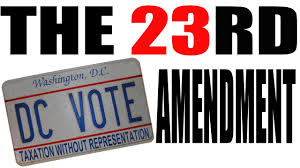
The 23rd amendment 1961:
The District constituting the seat of government of the United States shall appoint in such manner as the Congress may direct:
A number of electors of President and Vice President equal to the whole number of Senators and Representatives in Congress to which the District would be entitled if it were a state, but in no event more than the least populous state; they shall be in addition to those appointed by the states, but they shall be considered, for the purposes of the election of President and Vice President, to be electors appointed by a state; and they shall meet in the District and perform such duties as provided by the twelfth article of amendment. The 12 article of amendment states: The electors shall meet in their respective states and vote by ballot for President and Vice-President, one of whom, at least, shall not be an inhabitant of the same state with themselves; they shall name in their ballots the person voted for as President, and in distinct ballots the person voted for as Vice-President, and they shall make distinct lists of all persons voted for as President, and of all persons voted for as Vice-President, and of the number of votes for each, which lists they shall sign and certify, and transmit sealed to the seat of the government of the United States, directed to the President of the Senate;--The President of the Senate shall, in the presence of the Senate and House of Representatives, open all the certificates and the votes shall then be counted;--the person having the greatest number of votes for President, shall be the President, if such number be a majority of the whole number of electors appointed; and if no person have such majority, then from the persons having the highest numbers not exceeding three on the list of those voted for as President, the House of Representatives shall choose immediately, by ballot, the President. But in choosing the President, the votes shall be taken by states, the representation from each state having one vote; a quorum for this purpose shall consist of a member or members from two-thirds of the states, and a majority of all the states shall be necessary to a choice. And if the House of Representatives shall not choose a President whenever the right of choice shall devolve upon them, before the fourth day of March next following, then the Vice-President shall act as President, as in the case of the death or other constitutional disability of the President. The person having the greatest number of votes as Vice-President, shall be the Vice-President, if such number be a majority of the whole number of electors appointed, and if no person have a majority, then from the two highest numbers on the list, the Senate shall choose the Vice-President; a quorum for the purpose shall consist of two-thirds of the whole number of Senators, and a majority of the whole number shall be necessary to a choice. But no person constitutionally ineligible to the office of President shall be eligible to that of Vice-President of the United States.
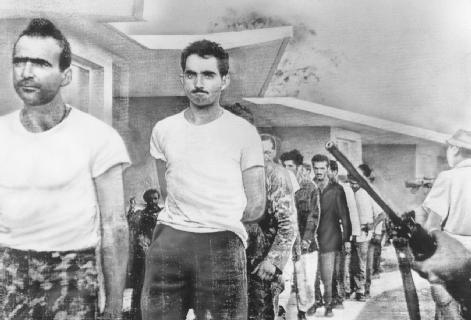
Bay of Pigs 1961:
In January 1961, U.S. government severed diplomatic relations with Cuba and stepped up its preparations from an invasion. Some State Department and other advisers to the new American president, JFK maintained that Castro posed no real threat to America. But the new president believed that masterminding the Cuban leader’s removal would show Russia, China and skeptical Americans that he was serious about winning the Cold War. Kennedy continued Eisenhower’s, CIA campaign to train and equip a Guerrilla army of Cuban exiles. He didn’t want an intervention by the American military in Cuba. On April 15, 1961 a group of Cuban exiles took off from Nicaragua, they conducted a strike against Cuban airfield. On April 17, 1961 they invaded the Southern shore known as the Bay of Pigs the invasion was a disaster. Unexpected coral reef s sank some of the exiles ships as they pulled into shore, paratroopers landed in the wrong side of the place. Before long, Castro’s troops had pinned the invaders on the beach and the exiles surrendered after less than a day of fighting, 114 were killed, 1,100 were taken prisoners.
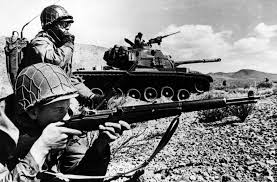
The Berlin Crisis 1961:
As the new administration of U.S. Pres. John F. Kennedy took office in 1961, the Berlin situation heated up. At the Vienna Summit in June 1961, Khrushchev reiterated his threat that if a Berlin agreement was not achieved by December, the Soviet Union would sign a separate treaty with East Germany (an arrangement that West Berlin Mayor Willy Brandt disparagingly characterized as Khrushchev “marrying himself”). Kennedy made it clear that Berlin was of supreme strategic importance to the United States and that free access to the city had to be maintained.
By July 1961 American officials estimated that over 1,000 East German refugees were crossing into West Berlin each day, an economic and demographic drain that, left unchecked, would spell disaster for the East. On the night of August 12–13, 1961, the East German government, backed by the Soviet Union, began to build a barrier between East Berlin (the Soviet-occupied sector) and West Berlin. The United States did not intervene because the Soviet Union was exercising control over its sector. When Khrushchev’s December 1961 deadline passed without incident, the conflict over the future of the city receded with no further Soviet agitation concerning a treaty.
A major outcome of the Berlin crisis was a new understanding between the United States and the Soviet Union. The Soviet Union would continue to have dominance over its eastern European allies and East Berlin, while the United States and its allies would claim western Europe, West Germany, and West Berlin within their sphere of influence.
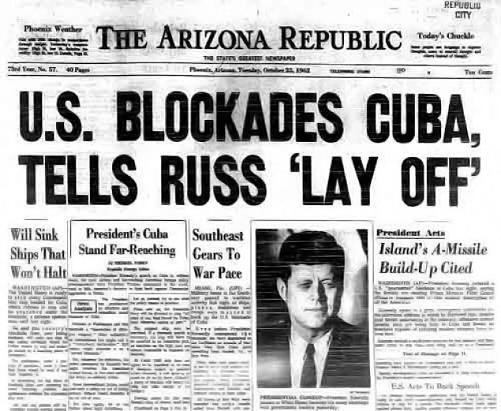
Cuban Missile Crisis 1962:
A U2 spy plane discovers missiles in Cuba. Air Force Pilot Richard Heyser takes photos of Russian medium range missiles. Soviet leader Nikita Khrushchev has asked Cuba’s President Fidel Castro if he could put them there. Ex-Comm, a group of American political leader, met for first time to discuss the Soviet missiles, Ex- Comm will met several times throughout the crisis, and the members rarely agreed on what to do. More photos show the missiles sites were analyzed, and show that Cuba also has long-range of Soviet missiles with the capability of traveling 2,200 miles. Robert Kennedy met with Soviet Foreign Ministers Andreil Gromyko, but Andreil never mentioned anything about the missiles. Gromyko told Kennedy that the only help the Soviet Union was giving to Cuba was assistance growing crops and missiles that are only for defense. Ex-Comm discusses sending U.S ships to Cuba this was to prevent Soviet ships to get to Cuba. This was called quarantine because a blockade was an act of war. Ted Sorenson writes one of the most important speeches that President Kennedy ever gave, which was televised for the entire nation to know what was happening at the time. Khrushchev orders Soviet ships to Cuba to stop at 750 miles away, preventing a confrontation with US, that around Cuba although Soviet submarines trailed behind U.S. ship as they move into place Khrushchev refuses to move missiles from Cuba saying the U.S. will not intimidate the Soviets. He also accused President Kennedy for putting the world at risk of a nuclear war by ordering the quarantine. Finally after meetings and talk they agree that America was not invading Cuba, and Khrushchev gives a speech on Radio Moscow and says that he has agreed to Kennedy’s arrangement the missiles will be remove so Cuba will not be invaded an crisis comes to an end.
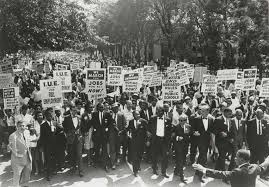
The March on Washington 1963:
As blacks faced continuing discrimination in the postwar years, the March on Washington group met annually to reiterate blacks’ demands for economic equality. The civil rights movement of the 1960's transformed the political climate, and in 1963, black leaders began to plan a new March on Washington, designed specifically to advocate passage of the Civil Rights Act then stalled in Congress. Chaired again by A. Philip Randolph and organized by his longtime associate, Bayard Rustin, this new March for Jobs and Freedom was expected to attract 100,000 participants. President John F. Kennedy showed as little enthusiasm for the march as had Roosevelt, but this time the black leaders would not be dissuaded. The National Association for the Advancement of Colored People and the Southern Christian Leadership Conference put aside their long-standing rivalry, black and white groups across the country were urged to attend, and elaborate arrangements were made to ensure a harmonious event. The growing disillusion among some civil rights workers was reflected in a speech planned by John Lewis of the Student Non-Violent Coordinating Committee, but in order to preserve the atmosphere of goodwill, leaders of the march persuaded Lewis to omit his harshest criticisms of the Kennedy administration.
The march was an unprecedented success. More than 200,000 black and white Americans shared a joyous day of speeches, songs, and prayers led by a celebrated array of clergymen, civil rights leaders, politicians, and entertainers. The Reverend Dr. Martin Luther King’s soaring address climaxed the day; through his eloquence, the phrase “I Have a Dream” became an expression of the highest aspirations of the civil rights movement.
Like its predecessor, the March on Washington of 1963 was followed by years of disillusion and racial strife. Nevertheless, both marches represented an affirmation of hope, of belief in the democratic process, and of faith in the capacity of blacks and whites to work together for racial equality.
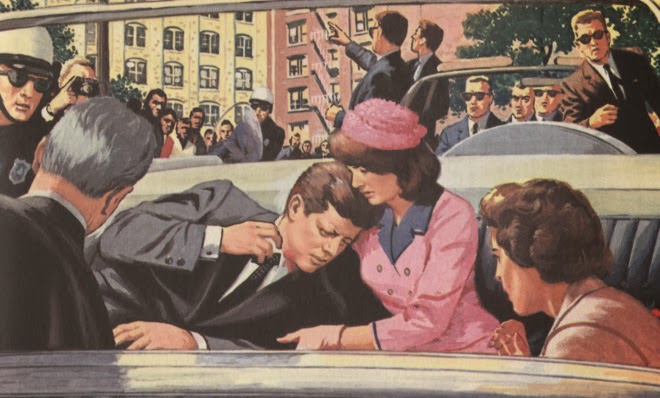
John F. Kennedy Assassination 1963:
President John F. Kennedy is killed by a sniper as he rides in an open convertible in Dallas, Texas. Kennedy was shot and killed on November 22nd, 1963. He died of a wound in the brain caused by a rifle bullet that was fired at him as he was riding through downtown. President Kennedy was shot at 12:30PM. He was pronounced dead at 1:00PM. The killer fired the rifle from a building just off the motorcade route. Mrs. Kennedy was in the hospital near her husband when he died, but not in the operating room. When the body was taken from the hospital in a bronze coffin about 2:00 PM. Mrs. Kennedy waked beside it. This was one the saddest moments in history that our beloved President was killed.
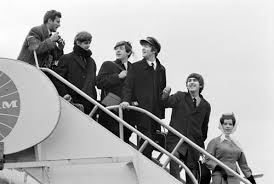
The Beatles Arrive 1964:
On February 7, 1964, Pan Am Yankee Clipper flight 101 from London Heathrow lands at New York’s Kennedy Airport–and “Beatlemania” arrives. It was the very first visit to the United States by the Beatles; a British rock-and-roll quartet that had just scored its first No. 1 U.S. hit six days before it came with “I Want to Hold Your Hand.” Two days later, Paul McCartney, age 21, Ringo Starr, 23, John Lennon, 23, and George Harrison, 20, made their first appearance on the Ed Sullivan Show, a popular television variety show, an estimated 73 million U.S. television viewers, tuned in to watch. Sullivan immediately booked the Beatles for two more appearances that month. The group made their first public concert appearance in the United States on February 11 at the Coliseum in Washington, D.C., and 20,000 fans attended. The next day, they gave two back-to-back performances at New York’s Carnegie Hall, and police were forced to close off the streets around the venerable music hall because of fan hysteria. On February 22, the Beatles returned to England.
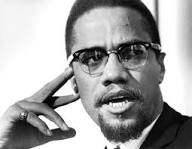
Malcolm X Assassination 1964:
On Feb. 21, 1965, the former Nation of Islam leader Malcolm X was shot and killed by assassins identified as Black Muslims as he was about to address the Organization of Afro-American Unity at the Audubon Ballroom in Harlem. He was 39.
Malcolm X rose quickly in the organization and traveled the country preaching the message of the Black Muslims, including the belief that blacks were superior to whites, that blacks and whites should be segregated and that blacks must protect themselves “by any means necessary.” A charismatic speaker, he won thousands of converts.
In the 1960's, Malcolm X clashed with Elijah Muhammad, the leader of the Nation of Islam, over the direction of the organization among other issues. In 1963, Muhammad suspended Malcolm X from the organization as punishment for his comment that the assassination of President John F. Kennedy was an example of “the chickens coming home to roost.” In 1964, Malcolm X broke with the Nation of Islam and converted to traditional Islam. He made a pilgrimage to Mecca, where he began to question his beliefs after seeing Muslims of all races coming together in peace. He changed his name to El-Hajj Malik El-Shabazz and upon his return to the United States began espousing less confrontational and separatist views on race relations.
Malcolm X received many death threats from Nation of Islam members. His home in New York, in Queens, was set on fire on Feb. 14, 1965, a week before his death. The Feb. 22 New York Times presented quotations from an interview he gave on Feb. 18: “I’m a marked man. It doesn’t frighten me for myself as long as I felt they would not hurt my family. … No one can get out without trouble, and this thing with me will be resolved by death and violence.”
Black Power1966:
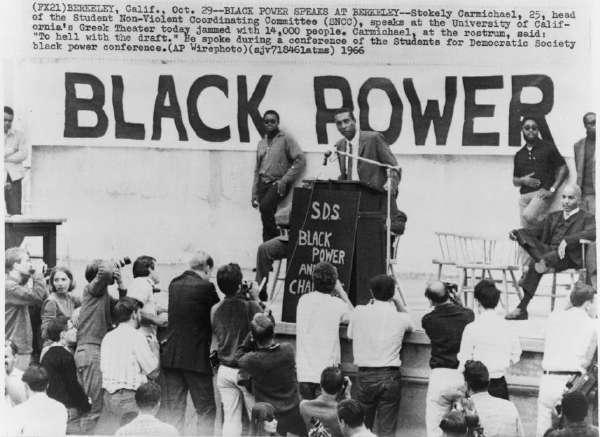
On June 5, 1966, James Meredith was shot in an ambush as he attempted to complete a peaceful march from Memphis, Tennessee, to Jackson, Mississippi. Civil rights leaders such as Martin Luther King, Floyd McKissick of core, Stokely Carmichael of SNCC rushed to Meredith`s hospital bed. They determined that his march must be completed. At a mass rally, Carmichael uttered the simple statement “what we need is black power.” Crowds chanted the phase as a slogan, and a movement to flower. Carmichael felt that blacks needed to feel a sense of racial pride and self-respect before any meaningful gains can be achieved. He encouraged the strengthening African American communities without the help of whites. Soon African American students began to celebrate their culture boldly and publicly.
The Detroit Riot 1967:
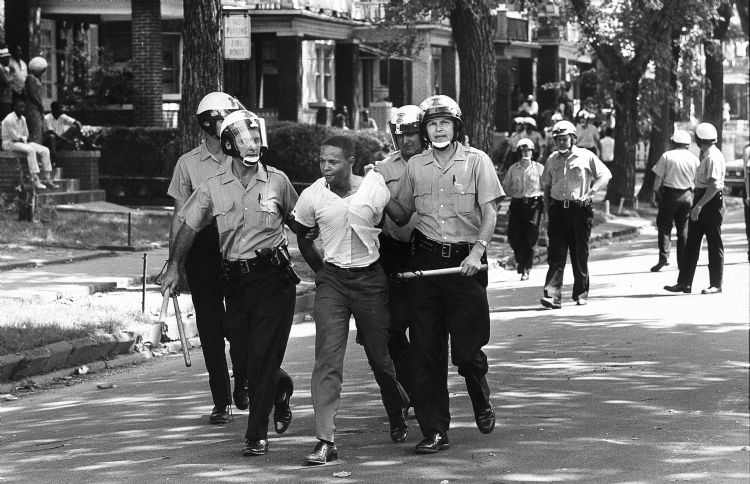
The Detroit Riot of 1967 in July 23rd early morning hours on of the worst riots in U.S. history breaks out on 12th Street in the heart of Detroit’s predominantly African American inner city. At night, 12th street was a center of Detroit inner city night life, both legal and illegal. The police raid on an unlicensed bar this was the cause of he is terrifying riot lasting 4 days and nights, left thousands injured and dead. Thousands were arrested. Businesses looted, hundreds of buildings utterly destroyed and Detroit’s reputation in tatters. The reasons behind the riot, of course are far thornier-socially, economically, and racial then a mere raid on a gin joint.
Peace Movement 1967:
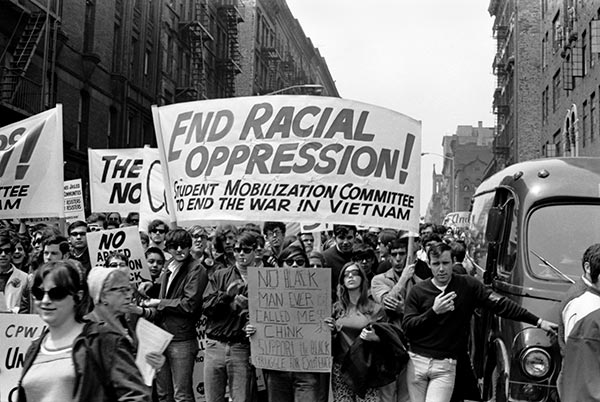
In 1965 through 1968 was the emergence of Civil Rights leader as active proponents of peace in Vietnam. In January 1967 an article was written for the Chicago Defender Peace movement in the U.S. Martin Luther King Jr. openly expressed support for antiwar movement on moral grounds. Reverend King expanded on his views in asserting that the wars drained much needed resources from domestic programs. He also voiced concern about the percentage of African Americans causalities in relation to the total population. King’s statements rallied African American activist t other antiwar cause and established a new dimension to the moral objections of the movement. The peaceful phase of the antiwar movement had reached maturity as the entire nation was now aware that the foundations of admiration foreign policy widely questioned.
Martin Luther King Assassination1968:
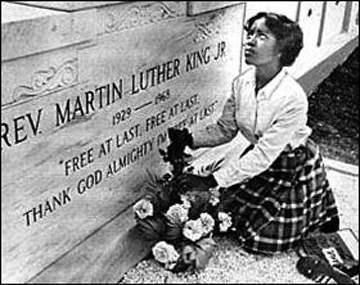
In early April 1968, shock waves reverberated around the world with the news that U.S civil rights leader Martin Luther King Jr. had been assassinated in Memphis, Tennessee. King was a Baptist minister and founder of the Southern Christian Leadership Conference (SCLC), since the mid-1950`s, using a combination of words and non-violent tactics such as sit-ins, boycotts and protest marches. His assassination led to outpouring of anger among Black Americans. In the last years of his life, King faced mounting criticism from young African American activists who favored a more confrontational approach to seeking change. King and other SCLC members were called to Memphis, Tennessee to support a sanitation workers` strike. Just after 6 p.m. the following day, King was standing on the second-floor balcony of the Lorraine Motel, where he and associates were staying, when a sniper`s bullet struck him in the neck. He was rushed to the hospital, where he was pronounced dead an hour later, at the age of 39. King`s death sparked rioting in more than 100 cities around the country, including burning and looting.
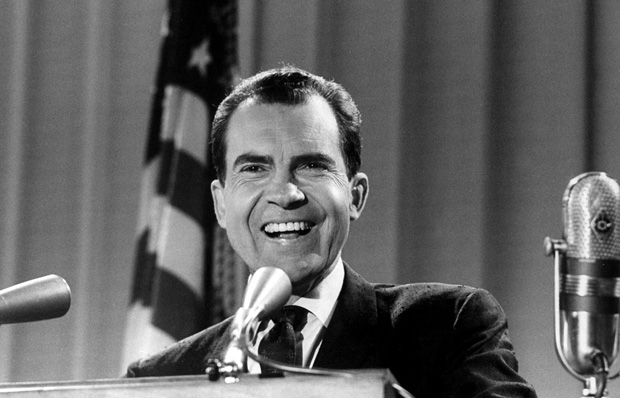
Richard Nixon Elected President 1968:
Richard Nixon is elected President of the United States on November 5, 1968. Richard M. Nixon defeated Democrat Hubert H. Humphrey. It was one of the closest elections in the U.S. history. This happened because of the third party candidate George Wallace, neither Nixon nor Humphrey received more than 50 percent of the popular vote. Nixon beat Humphrey by less then 500,000 votes. Nixon prunes to bring peace to the streets. Foreign policy was also a major factor in the election. Nixon also promised he would find way to “peace with honor” in Vietnam; the American people wanted the war to end and gave Nixon the opportunity to become president. The American people voted on November 5th 1968, and he became president of the U.S. Even though it was a close election, he won the presidency.
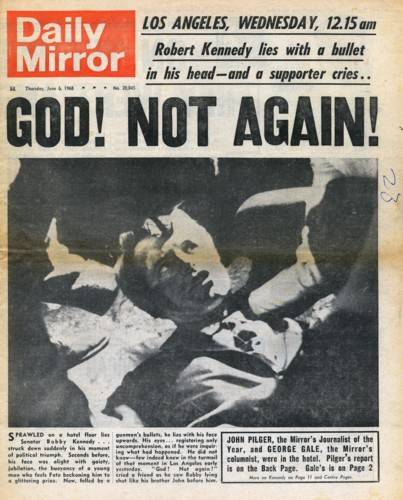
Robert Kennedy Assassination1968:
Senator Robert Kennedy was shot at the Ambassador Hotel in Laos Angeles after winning the California presidential primary. Immediately after he announced to his cheering supporters that the country was ready to end its fractious divisions, Kennedy was shot several times by 22 year old Palestinian Sirhan Sirhan. Robert Kennedy was perceived by many to be the only person in American politics capable of uniting the people. Robert Kennedy was love by the minority community for his integrity and devotion to the Civil Rights Movement. Kennedy was exiting the Ambassador hotel, Sirhan Sirhan stepped forward with a rolled up campaign poster, hiding a 22 revolver. He was only a foot away when he fired several shots at Kennedy. Sirhan confessed to the crime.
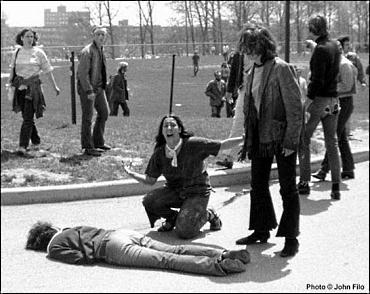
Kent State Massacre 1970:
On April 30th, 1970 President Richard M. Nixon appeared on national television to announce the invasion of Cambodia by the United states and the need to draft 150,000 more soldiers for an expansion the Vietnam War effort. This provoked massive protest on compasses throughout the country. At Kent State University in Ohio, protesters launched a demonstration that included setting fire to the ROTC building prompting the governor of Ohio to dispatch 900 National Guardsmen to the campus. During an altercation on May 4th, 28 guardsmen fired on a crowd, killing 4 students and killing 9. A report by the President’s Commission on Campus Unrest did acknowledge, however that the action of the guardsmen had been unnecessary, unwarranted, and inexcusable. “Eventually, the grand jury indicted the eight guardsmen, but the charges were dismissed for lack of evidence. In the coverage of the events of Kent State, the media used a photo taken by a fellow student; a woman knelled in anguish, arms upraised, beside one of the slain students.
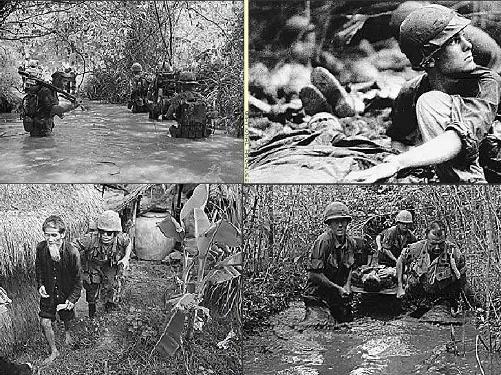
Cambodian invasion creates anti-war turbulence 1970:
In May 8th, 1970 President Nixon, defend the U.S. troop movement into Cambodia saying that it will be a 6 to 8 of time to trained the South Vietnamese forces and will short the war for Americans. The announcement that U.S. and South Vietnamese troop ad invaded Cambodia resulted in a firestorm of protest and gave the antiwar movement a new rolling point. College students across the nation intensified their antiwar protest with marches, rallies and scattered incidents of violence. About 400 schools were affected by strikes and more than 200 colleges and universities closed completely. Those cause protest and the deaths at Kent State University and the later at Jackson State Mississippi. More than 250 State William Rogers criticizing Y.S military involvement in Cambodia. In addition there were a series of congressional resolution, legislative and initiatives that attempted to limit severely the executive war-making powers of the President.
