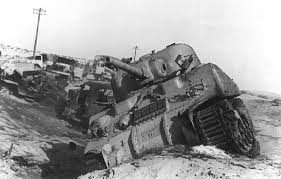
The Suez Crisis 1956:
The Israelis struck first, on October 26, 1956. Two days later, British and French military forces joined them. Originally, forces from the three countries were set to strike at once, but the British and French troops were delayed.
Behind schedule, but ultimately successful, the British and French troops took control of the area around the Suez Canal. However, their hesitation had given the Soviet Union–also confronted with a growing crisis in Hungary–time to respond. The Soviets, eager to exploit Arab nationalism and gain a foothold in the Middle East, supplied arms from Czechoslovakia to the Egyptian government beginning in 1955, and eventually helped Egypt construct the Aswan Dam on the Nile River after the United States refused to support the project. Soviet leader Nikita Khrushchev railed against the invasion and threatened to rain down nuclear missiles on Western Europe if the Israeli-French-British force did not withdraw.
The response of President Dwight Eisenhower’s administration was measured. It warned the Soviets that reckless talk of nuclear conflict would only make matters worse, and cautioned Khrushchev to refrain from direct intervention in the conflict. However, Eisenhower also issued stern warnings to the French, British and Israelis to give up their campaign and withdraw from Egyptian soil. Eisenhower was upset with the British, in particular, for not keeping the United States informed about their intentions. The United States threatened all three nations with economic sanctions if they persisted in their attack. The threats did their work. The British and French forces withdrew by December; Israel finally bowed to U.S. pressure in March 1957.
In the aftermath of the Suez Crisis, Britain and France found their influence as world powers weakened.
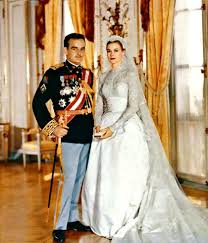
Grace Kelly gets married to Prince Rainier of Monaco 1956:
American actress Grace Kelly marries Prince Rainier of Monaco in a spectacular ceremony on this day in 1956. While filming another Hitchcock movie, To Catch a Thief (1955), in the French Riviera, Kelly met Prince Rainier of Monaco. It wasn’t love at first sight for Kelly, but the prince initiated a long correspondence, which led to their marriage in 1956. Afterward, she became Princess Grace of Monaco and retired from acting. She had three children and occasionally narrated documentaries. Kelly died tragically at the age of 52 when her car plunged off a mountain road by the Cote D’Azur in September 1982.
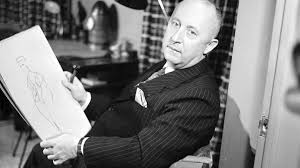
Christian Dior dies 1957:
Montecatini, Italy, Thursday, Oct. 24 Christian Dior, for many years the leader in the world of fashion design, died here early today of a heart attack. His age was 52.
Dior, who tended to conservative suits and ties for his own attire, died at the Hotel La Place. He had been vacationing in northern Italy for that last week.
Dior's greatest feat was the "New Look" in 1947, when he seized and held for France the style leadership of the world after it had threatened to pass to the United States in the post-war years. For his achievement the French Government awarded the Legion of Honor to him.
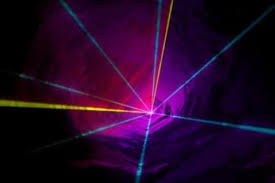
First lasers developed 1957:
Schawlow found the key — put the atoms you wanted to stimulate in a long, narrow cavity with mirrors at each end. The rays would shuttle back and forth inside so that there would be more chances for stimulating atoms to radiate. One of the mirrors would be only partly silvered so that some of the rays could leak out. This arrangement (the Fabry-Pérot etalon) was familiar to generations of optics researchers.
The same arrangement meanwhile occurred to Gordon Gould, a graduate student at Columbia University who had discussed the problem with Townes. For his thesis research, Gould had already been working with "pumping" atoms to higher energy states so they would emit light. As Gould elaborated his ideas and speculated about all the things you could do with a concentrated beam of light, he realized that he was onto something far beyond the much-discussed "infrared maser". In his notebook he confidently named the yet-to-be-invented device a LASER (for Light Amplification by Stimulated Emission of Radiation). And sooner than later it was created.
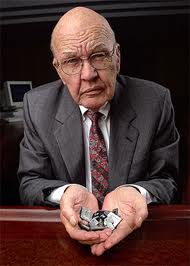
Microchips invented 1959:
On March 24, 1959, at the Institute of Radio Engineers' annual trade show in the New York Coliseum, Texas Instruments, one of the nation's leading electronics firms, introduced a new device that would change the world as profoundly as any invention of the 20th century—the solid integrated circuit, or, as it came to be called, the microchip. Without the chip, the commonplace conveniences of modern life—personal computers, the Internet, anything involving digital technology and displays, even something as simple as the handheld calculator—would be the stuff of science fiction. But few detected the invention's significance at the time. It was an era of wondrous technological advances—rockets, jet passenger planes, computers, and seemingly magical pills that altered human chemistry. Who could tell whether some new gizmo—one of dozens in development—would be a transformation or a fizzle?
